When Dracula Followed Me Home: Theatre, Live Cinema, and a Thought I Cannot Shake
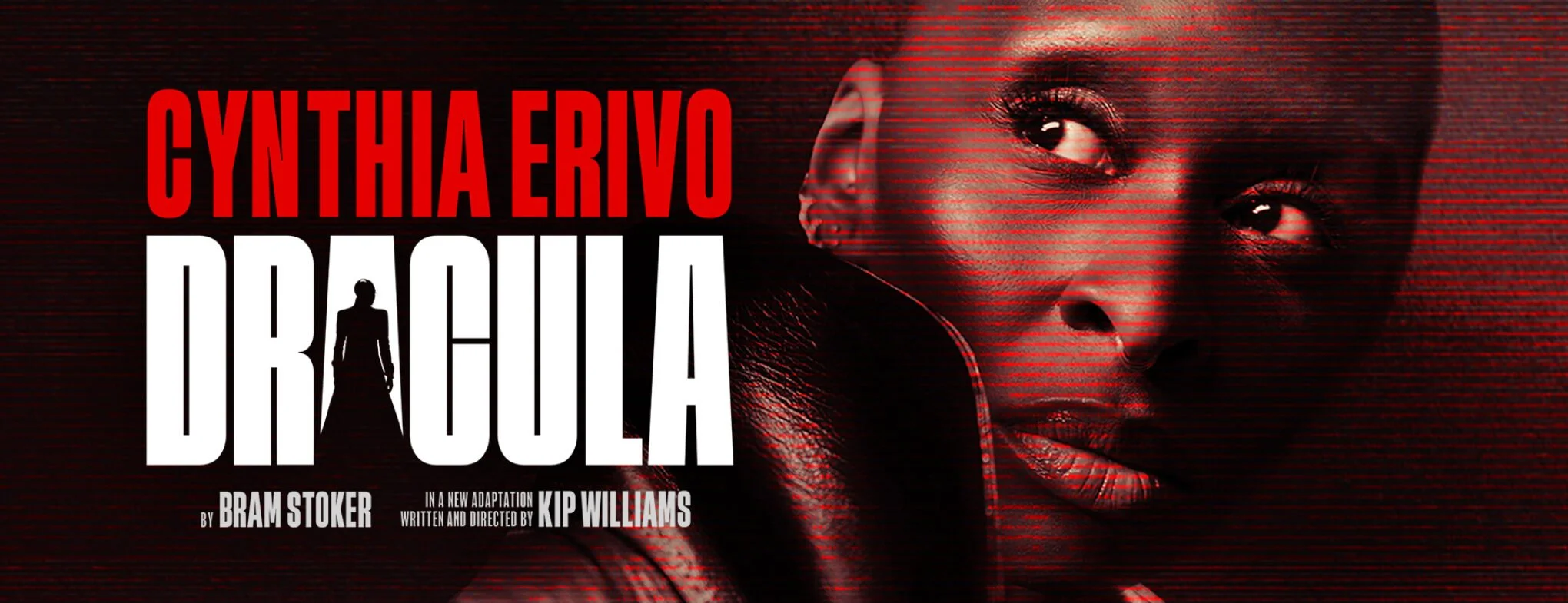
“A camera and cinema, combined with theatre, can do extraordinary things.” Kip Williams (ABC)
I have always had a weakness for vampires. Anyone who has seen my short film Isabeau (2023) probably knows that already.
It is not just because vampires belong to the enduring mythology of horror. It is because they let storytellers explore such rich tensions: fear and attraction, beauty and decay, elegance and violence, immortality and loneliness. The best vampire stories are never simply about the supernatural. They are about power, repression, memory, obsession, and the parts of human nature that refuse to stay buried.
That is probably why seeing Kip Williams’ Dracula with Cynthia Erivo at the West End this weekend stayed with me so strongly.
I went to the theatre expecting something bold but I did not do any research to know what kind of production it was. All I knew it was a one woman show. I respect Cynthia Erivo’s talent but Stolker’s creation was the main driving force. that. But I came out with that rare feeling that something had genuinely shifted in my thinking. This was not just a strong performance. It was not just a clever adaptation. It was one of those evenings that makes you rethink the borders between art forms. That is ingrained in my mind forever.
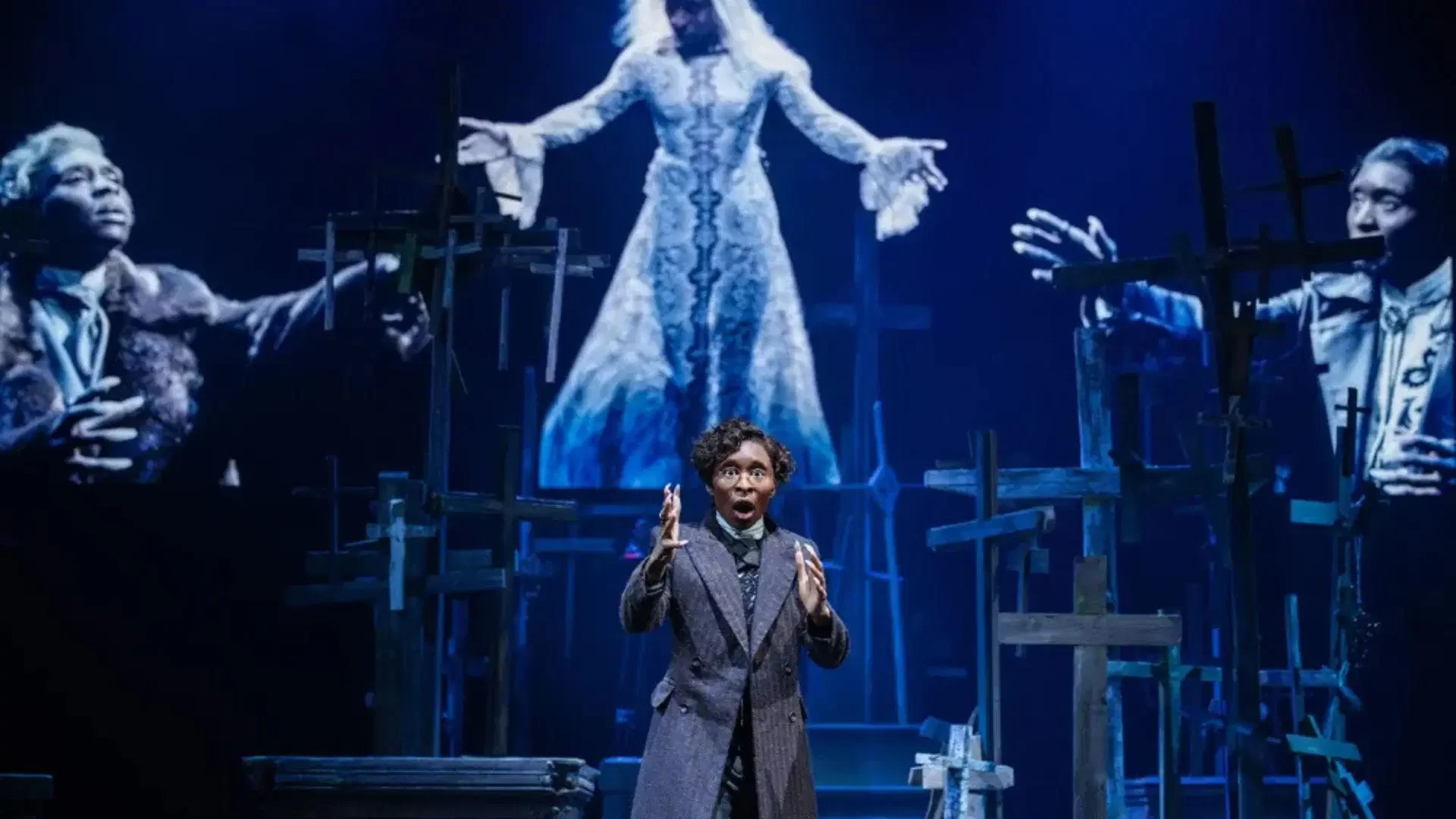
What I saw was theatre, yes. But it was also filmmaking. And not in the usual, “vanilla” sense of “there was a screen involved.” This production uses live cameras, live projection, and pre-recorded material as part of its storytelling language. Official material describes it as part of Kip Williams’ “cine-theatre” approach, and the production is built around Cynthia Erivo performing all 23 roles herself.
That was the part that really caught me.
The cameras were not simply recording the action. They were participating in it. They were shaping point of view, scale, intimacy, and rhythm in real time. At moments, it felt like I was watching a film being assembled live on stage. At other moments, it felt as though the screen had become another acting space altogether., compositing previously recorded footage of Erivo dialoging with her live performance. The result was strange, controlled, and deeply expressive. It had the thrill of theatre, but it also had the visual intimacy of cinema.
And the blocking. My God, the blocking. Goosebumps!
I kept thinking about the sheer amount of preparation behind it all. Not only performance preparation, but technical preparation. Camera choreography. Timing. Rehearsal. Precision of movement. The kind of pre-production that must look almost military on paper, but on stage feels fluid and alive. That, to me, is always the magical part. When an audience feels spontaneity, but what they are really witnessing is an extraordinary degree of planning. I could not think of better argument to show my students the importance of preproduction.
What I appreciated even more, though, is that the camera work did not feel ornamental. It had a reason to exist.
Williams himself has spoken very clearly about this. In an interview with ABC, he explains that Dracula is especially suited to this hybrid language because Bram Stoker’s novel is built from diaries and letters, from confession and interiority. He says that camera and cinema, combined with theatre, can take us “into the unconscious of a character” and “into the dreamscape of a character.” That is such a precise and useful idea. It explains why the production does not feel like theatre trying to be fashionable. It feels like form answering the demands of the material.
And once I started thinking about it that way, I stopped thinking only as a spectator and started thinking as a teacher.
That is always the danger, of course. We never really switch off.
Earlier in the day I went to watch Project Hail Mary at BFI IMAX and my teacher’s brain was on automatically but that’s a blogpost for next week.
The whole experience made me think about our schools, our students, and the possibilities that open up when IB Theatre and IB Film stop orbiting each other politely and actually collide in a creative big bang.
Because honestly, what an opportunity that would be.
The IB Film guide is very clear that DP Film students experiment with film and multimedia technology, that the course emphasizes collaboration, and that learning in film must be experienced practically. It also stresses effective teamwork, inquiry, action, and reflection as central to the course.
That language matters. It reminds us that collaboration is not an optional extra in IB Film. It is part of the DNA of the course. It’s so important that the Higher Level assessment is called Collaborative Film Project.
The same point comes through strongly in the subject reports. The 2025 edition keeps returning to collaboration as something students need to understand, document, and reflect on over time, not merely describe at the end of a project. Stronger work, according to the reports, tends to show specific insight into how roles interact and how collaboration contributes to shared artistic intentions. (Subject Report, 2025)
So when I imagine a real IB Theatre and IB Film crossover, I do not see it as a side project. I see it as a natural extension of what both courses already value.
What would that look like in practice?
Not filming a school play. Not “the theatre students act while the film students record.” That is too simple, and frankly not very interesting.
I am thinking instead of a genuinely hybrid production. Something where the stage action and the screen language are conceived together from the start. Something where blocking matters for the live audience and for the camera. Something where the actor has to think about presence in space, but also framing, timing, and proximity. Something where the cinematographer is not a passive observer but part of the storytelling on stage, making the camera a character. Something where rehearsal becomes part theatre process and part film pre-production.
That is where it gets exciting.
A short gothic scene would be ideal. A confession. A haunting. A memory. A letter read aloud while another version of the same character appears on screen. A live close-up that reveals something the stage image cannot. A projected image that challenges what we think we are seeing in front of us. The possibilities feel endless, and not because the technology is flashy, but because it allows students to think in two artistic languages at once.
And the educational value is huge.
Theatre students would have to think about performance for live space and for the lens. Film students would have to think about camera placement, live image capture, visual rhythm, and the ethics of what the camera chooses to reveal. Both groups would have to think more seriously about collaboration, because neither discipline could dominate the piece without weakening it.
That, to me, is fertile ground for teaching.
It is also not as unrealistic as it may sound. Schools are already experimenting with this kind of form. Whitgift School, for example, staged a semi-immersive production of It’s a Wonderful Life that combined theatre with real-time projections and live cinematography. That is exactly the sort of school-based experiment that makes me think this territory is not only possible, but increasingly relevant.
And yet I do not think the answer is to start big.
Actually, I think the answer is the opposite.
I am in that exciting creative stage of plenty of brainstorming.
Start with one short scene. One or two actors. Two cameras. One projection surface. Clear artistic intentions. A visible process. Enough rehearsal to let students discover that stage grammar and screen grammar do not always cooperate politely. Let them wrestle with that. Let them make mistakes. Let them discover that sometimes the most interesting creative work happens not when the forms merge perfectly, but when they resist each other a little.
That resistance can be very productive.
Perhaps that is what moved me most about Dracula. Not only the ambition of it, and not only the technical wizardry, but the reminder that form still matters. That adaptation still matters. That the question “why this medium?” is still one of the best questions we can ask our students.
It also reminded me that schools should be a little braver.
We are sometimes too quick to separate the arts into tidy rooms. Theatre here. Film there. Performance in one corridor. Camera work in another. But some of the most memorable learning happens in the messy borderlands, where students have to invent the method as well as the meaning. I am especially lucky because my IB Theatre colleague is already proving how powerful that kind of creative mess can be. Her student-led productions, shaped by students from script to direction, are producing truly exciting results, and our theatre programme is flourishing because of it. Seeing that makes me ask myself whether I might soon find a way for some of my IB Film Year 1 students to step into that space too, and contribute to the kind of bold, collaborative work she is already leading so successfully.
I would genuinely love to hear from other IB Film or IB Theatre teachers who have tried something like this. Have you brought live cameras into performance? Have you built a production where theatre and film shared the same artistic language? What worked? What collapsed? What would you change the next time?
Because after this Dracula, I cannot stop thinking about it.
And perhaps that is the best thing any performance can do. Not just impress us for one evening, but quietly follow us home, inside our minds.